How Stable Is the 9929 VPS Network Route?
When shopping for a US server, many users ask the same question: how good is 9929 VPS route quality, really? As one of the top-tier routes commonly used to reach US servers from mainland China, AS9929 carries a large share of cross-border traffic, and its stability directly shapes website loading speed, gaming latency, and the overall cross-border office experience. Below, we cover the technical background, routing mechanism, real-world performance, the factors that affect stability, and how to test it yourself.
What Is the 9929 Route?
AS9929 is an international premium route operated by China Unicom, officially known as CUII (China Unicom Internet International). It belongs to an entirely different routing system from China Unicom's common AS4837 general-purpose route.
From a BGP route-announcement standpoint, AS4837 announcements are broader and more likely to run into congestion or detours where they meet other carriers at the international gateway. The 9929 route, by contrast, holds its own AS number block and dedicated egress bandwidth at the backbone level, giving it shorter paths, fewer hops, and higher transmission priority.
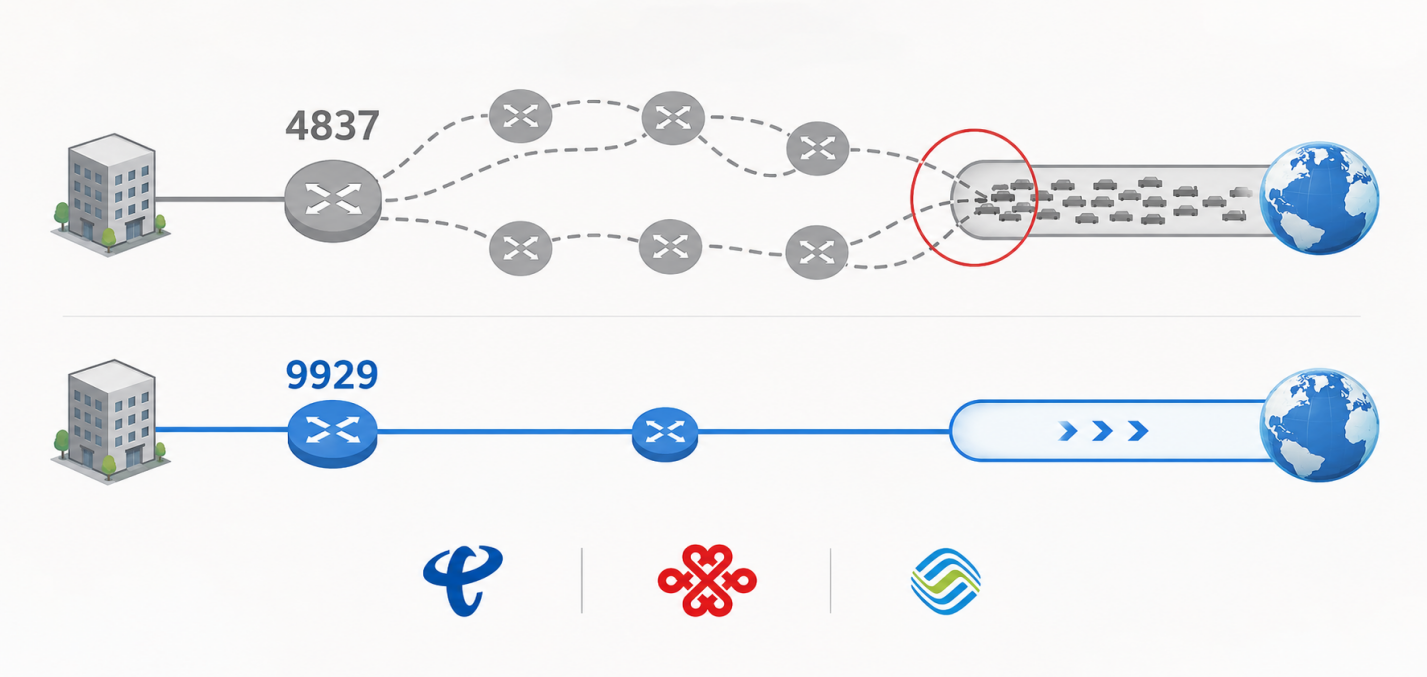
The core advantage of the 9929 route is that it uses a dedicated channel at the international gateway, so its packets never have to compete with general traffic for egress capacity. This structural separation is what eliminates detours, jitter, and cross-carrier congestion at the source — and it's exactly why the route is known as a "premium line."
Each of China's three major carriers runs its own premium route: China Unicom uses AS9929, China Telecom uses CN2 GIA, and China Mobile uses CMIN2. None of these three networks are interconnected at the infrastructure level, so users who want comprehensive stability typically choose a tri-network line combination, which automatically routes each visitor over the optimal path for their carrier.
Real-World Stability of 9929 Route VPS
What ultimately matters to users is how a 9929 route VPS performs in daily use, not just its theoretical specs. Extensive testing shows that latency on this route typically stays in the 120–160ms range during normal hours (measured from major mainland Chinese cities to the US West Coast), with relatively little fluctuation.
Even during peak evening hours in China (8 PM to 11 PM), a 9929 route VPS shows noticeably less latency variance than a standard international route — typically no more than a 10–15% increase — and packet loss stays under 1%, which matters a great deal for connections that need to stay stable over long periods.
By comparison, ordinary BGP routes often see latency spike more than 50% during peak hours, sometimes accompanied by intermittent packet loss — a gap that's very noticeable to real users. This resilience during peak hours is exactly the core value of a 9929 route VPS.
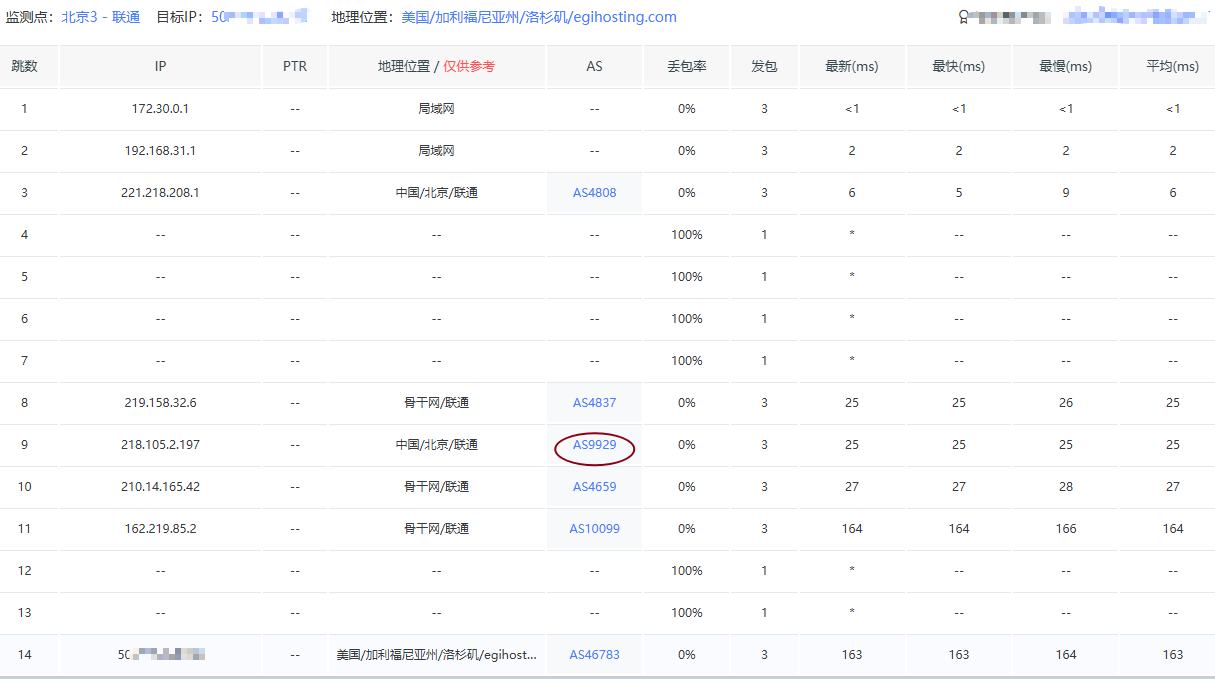
Factors Affecting 9929 VPS Route Stability, and How to Test It
Route stability isn't determined by the route alone — data center infrastructure, peering quality, bandwidth capacity, and DDoS protection all play a role, making it a systemic engineering challenge.
Whether the BGP sessions between the data center and its upstream carriers stay stable, and how fast route convergence happens, directly determines how quickly the line recovers when something fails. Beyond that, sufficient egress bandwidth determines whether queuing delays appear during peak periods, and a route without solid protection can suffer widespread disruption or even a full outage once it comes under DDoS attack, affecting every user sharing that route's resources.
To verify whether a VPS genuinely routes through 9929, you can use a tool like ITDOG or a similar third-party diagnostic script to trace the path a packet takes and confirm whether it passes through China Unicom's dedicated international gateway node — this is the most direct way to judge the route's real-world stability.
VMRack's Real-World Performance on the 9929 Route
VMRack runs on a self-built data center in Los Angeles, and its tri-network premium VPS line (L3) combines CN2 GIA, AS9929, and CMIN2 — the three top-tier routes — with peak-hour stability and low latency as its core strengths.

Because the data center is fully self-built, VMRack has complete, independent control over its network resources. This allows fine-grained tuning of route quality — optimizing BGP routing policy, adjusting MTU settings, and tuning TCP congestion control — without being limited by a third-party facility's resource allocation.
VMRack also supports multiple IPv4 addresses and private/internal IPs as part of a full-spectrum networking solution, along with flexible custom configurations and large bandwidth options to meet the differing network needs of various business scenarios.
Summary
Overall, 9929 VPS stands out for its independent routing system and dedicated international gateway design, delivering noticeably better peak-hour stability and latency control than ordinary BGP routes — making it a strong fit for users who demand a reliable cross-border access experience. When choosing a provider, it's worth testing actual performance yourself and prioritizing one with a self-built data center, ample bandwidth, and solid DDoS protection for a more consistently stable experience over the long run.
- Recommendation for High-Performance 9929 China Unicom Optimized VPS
- CN2 GIA vs. AS9929 vs. CMIN2: Which is the Stablest Outbound Route in 2026?
- Cost-Effective US Cloud Server Recommendation: Unveiling VMRack Los Angeles Node Performance
- Guide to Selecting US VPS Servers: The Advantages of Los Angeles Data Centers
- Recommended High-Performance VPS CN2 Servers and GIA Line Identification Guide


- Products
- VPS Hosting
- VPS HostingUnmetered
- Bare Metal
- GPU Rental
- CDNPublic Beta
- Custom CDN
- Object StoragePublic Beta
- TranscoderPublic Beta